
Curtain Cascades Waterfall of Tumpak Sewu


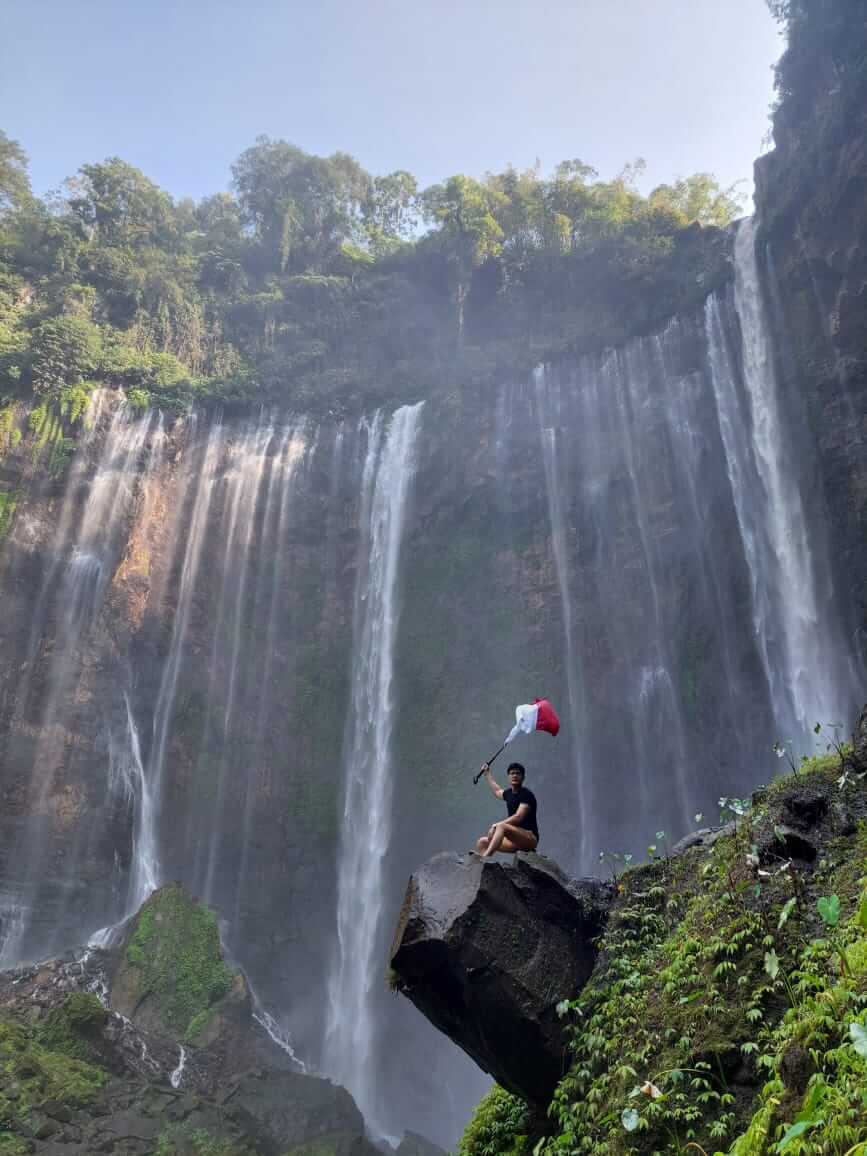
Tumpak Sewu Waterfall, also called Coban Sewu, is a waterfall with a height of about 120 meters. This waterfall is bordered by Lumajang Regency and Malang Regency, East Java Province. Tumpak Sewu Waterfall has a water flow that resembles a curtain, so it is included in the tiered waterfall type. The location of Tumpak Sewu Waterfall is in a steep, elongated valley with an elevation of 500 meters above sea level.
Tumpak Sewu Waterfall is formed in the flow of the Glidih River, which has its head on Mount Semeru. Tumpak Sewu Waterfall is located on the Malang-Lumajang border, East Java, between two villages, namely Sidomulyo Village, Pronojiwo District, Lumajang Regency, and Sidorenggo Village, Ampel Gading District, Malang Regency, East Java Province, Indonesia.
Spots in Tumpak Sewu
In Tumpak Sewu, there are five tourist spots. and if sorted from the entrance or counter, the order of the Tumpak Sewu Waterfall tourist spots is as follows:
- Panorama of Tumpak Sewu
- Bottom Waterfall
- Nirvana Cliffs
- Blue Lake
- Goa Drops
Nearby Destinations
Recommended Tours
- Bromo Sunrise Tumpak Sewu Tour from Surabaya
- Malang Tumpak Sewu Bromo Ijen Bali 3D2N Tour
- Surabaya to Bali 2D1N Tour: Tumpak Sewu & Bromo
- Surabaya to Bali 3D2N Tour: Tumpak Sewu Bromo Ijen
- Surabaya To Bali 4D3N Tour: Bromo Tumpak Sewu Ijen Bali
- Surabaya to Bali 5D4N Tour: Bromo, Tumpak Sewu, Ijen
- Surabaya Tumpak Sewu Bromo 2D1N Tou
- Surabaya to Bali 4D3N Tour: Tumpak Sewu Bromo Ijen Bali
How to Get Transport Service to Tumpak Sewu?
To assist you in visiting better Bromo Ijen Tumpak Sewu and other destination from Surabaya, we provide private transport service yo get to iconic destinations
This is a fantastic addition! Tumpak Sewu is growing in popularity and requires specific safety warnings due to its challenging trek.
FAQ
Here are 10 key points for an FAQ section on Tumpak Sewu Waterfall, focusing on the views, the difficulty, and essential gear.
The Waterfall & Experience
- 1. What makes Tumpak Sewu so unique?
Tumpak Sewu, often called the “Niagara Falls of Indonesia,” is unique for its appearance as a curtain-like fall. Water cascades down a horseshoe-shaped cliff face from many streams (the name means “a thousand waterfalls”), creating a stunning, wide, curtain of water approximately 120 meters high. It is set deep within a canyon with Mount Semeru often visible in the background from the viewing platform. - 2. How do I see the waterfall?
Are there different viewing spots? There are two main ways to experience Tumpak Sewu:- The Panoramic Viewpoint (Top View): An easy, short walk from the entrance that offers the famous sweeping view of the entire waterfall curtain and the surrounding canyon. This is accessible to most visitors.
- The Base/Plunge Pool (Bottom View): Requires a challenging trek down into the canyon to stand directly in front of the massive falls.
- 3. How difficult is the trek to the base of the waterfall?
The trek to the base is challenging and physically demanding and is not suitable for young children, the elderly, or those with mobility issues. The trail involves:- Descending steep, slippery dirt paths and concrete/bamboo ladders.
- Navigating through a stream/river section at the canyon floor.
- The round trip (down and back up) takes approximately 2–3 hours.
- 4. Is it mandatory to hire a local guide for the descent?
While it is not mandatory, it is highly recommended to hire a local guide, especially if you plan to descend to the base. The trail is often slippery, exposed, and involves using bamboo and rope handholds. A guide ensures safety, knows the safest paths, and can assist with the trickier crossings.
Logistics & Safety
- 5. What are the typical opening hours and entrance fees?
Tumpak Sewu is generally open daily from around 7:00 AM to 4:00 PM. There are often separate fees:- Viewpoint Fee: For access to the upper panoramic platform.
- Descent/Trek Fee: An additional fee for the trek down to the waterfall base. (Note: All entrance and local fees are usually cash-only in Indonesian Rupiah.)
- 6. What essential gear should I bring for the trek?
The trek involves water, mist, and very slippery rocks. Essential gear includes:- Waterproof/Quick-Dry Backpack/Dry Bag for electronics (phone, camera).
- Sturdy shoes with excellent grip (hiking sandals or water shoes are best). Flip-flops are strongly advised against.
- Quick-dry clothing (you will get wet from the mist near the base).
- Plenty of drinking water and snacks.
- 7. What is the best time of day and year to visit?
- Best Time of Day: Early morning (7:00 AM – 9:00 AM) is best to avoid crowds, enjoy cooler temperatures, and capture the best lighting conditions with less mist.
- Best Season: The dry season (April to October) offers safer, less slippery trails, although the waterfall volume might be slightly lower. The rainy season (November to March) brings a more powerful flow but significantly increases the risk of slippery paths and trail closures.
- 8. What is Goa Tetes, and is it worth visiting?
Goa Tetes (“Dripping Cave”) is a smaller, adjacent waterfall and cave system located near the base of Tumpak Sewu, accessible via a short detour from the main path. It is highly recommended and often included as part of the base trek, featuring small pools and unique rock formations. - 9. Where is the nearest major town to Tumpak Sewu?
The most common starting point for tours to Tumpak Sewu is the city of Malang, which is approximately a 2.5 to 3-hour drive away. The waterfall itself is located in the Lumajang Regency of East Java. - 10. Is it possible to combine Tumpak Sewu with Mount Bromo or Ijen Crater?
Yes, Tumpak Sewu is perfectly situated between the routes for Mount Bromo and Ijen Crater, making it an excellent stop on a multi-day East Java itinerary. Many tours combine a visit here with Bromo, either before or after the sunrise trip.